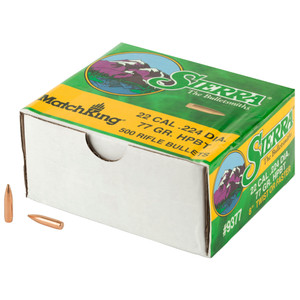
Sierra 7160 Tipped MatchKing .22 Cal .224 60gr, 100ct Box
$37.25
- Capacity-Rounds:
- 100
- Caliber-Gauge:
- 22 Caliber
- Grain:
- 60
- Quantity:
- 100 Per Box
- Bullet Tip Material:
- Polymer
- Jacket Material:
- Copper
- Recommended Usage:
- Varmint
- Sectional Density:
- 0.171
- Bullet Diameter:
- 0.224
The Sierra 7160 Tipped MatchKing .22 caliber rifle bullet combines the precision legacy of Sierra's MatchKing line with a modern acetal resin tip designed to reduce drag and improve ballistic performance. Built for competitive shooters and precision rifle enthusiasts, this 60-grain .224 diameter projectile delivers the accuracy you demand on the range or in match competition. The tipped design also enhances reliable feeding in magazine-fed firearms—a practical advantage when you're running multiple rounds downrange.
What sets the Tipped MatchKing apart is its superior ballistic coefficient compared to the traditional hollow-point MatchKing. The tip doesn't just look purpose-built—it meaningfully reduces air drag across the velocity envelope, translating to flatter trajectories and more consistent performance at distance. With sectional density of 0.171, this bullet balances construction for match-grade accuracy with the velocity characteristics common to .22 caliber competition loads.
These bullets are purpose-designed for precision rifle shooting, target competition, and varmint work where match-grade accuracy takes priority. Sierra doesn't recommend them for hunting applications requiring reliable expansion on game. If you're loading for a dedicated .22 competition rifle or a high-volume practice platform, the 60-grain Tipped MatchKing fills a legitimate gap in Sierra's match bullet lineup. Note that your barrel must have a twist rate of 1-in-10 or faster to stabilize this projectile properly.
This box contains 100 bullets, sized for standard .224 diameter chambers. Whether you're fine-tuning loads for a benchrest rig or stocking up for a season of competition, Sierra's reputation for consistency and shooters' trust in their matchgrades makes this a smart choice for reloaders serious about precision.
Key Features
- Acetal resin tip reduces drag for improved ballistic coefficient and flatter trajectories
- Enhanced magazine feeding reliability compared to traditional hollow-point MatchKings
- Match-grade design for competitive target shooting and precision rifle applications
- 60-grain weight optimized for .22 caliber competition and varmint loads
- 100 bullets per box for convenient reloading in volume
Specifications
| Caliber | .22 / .224" |
| Bullet Weight | 60 grains |
| Diameter | 0.224 inches |
| Sectional Density | 0.171 |
| Ballistic Coefficient (2700+ fps) | 0.323 |
| Ballistic Coefficient (1950–2700 fps) | 0.313 |
| Ballistic Coefficient (1700–1950 fps) | 0.283 |
| Ballistic Coefficient (below 1700 fps) | 0.253 |
| Minimum Barrel Twist Rate | 1-in-10 or faster |
| Box Count | 100 bullets |
Frequently Asked Questions
What barrel twist rate do I need for the Sierra 7160 Tipped MatchKing 60gr?
Your barrel must have a twist rate of 1-in-10 or faster to properly stabilize this bullet. If your rifle has a slower twist, these bullets are not recommended for your application.
Will these bullets work reliably in magazine-fed rifles?
Yes—one key advantage of the Tipped MatchKing design is improved reliable feeding in magazine-fed firearms compared to traditional MatchKing bullets. The tip geometry supports smoother feeding from the magazine into the chamber.
Are these bullets suitable for hunting?
No. Sierra specifically does not recommend Tipped MatchKing or standard MatchKing bullets for hunting applications. Their design prioritizes accuracy for target and competition shooting rather than the reliable expansion needed for ethical game harvests. For varmint work, Sierra offers purpose-designed alternatives like their Hornet Blitz or Varminter lines.
What is the ballistic advantage of the Tipped MatchKing over a standard MatchKing?
The acetal resin tip reduces drag, producing a higher ballistic coefficient and flatter trajectory. This translates to better long-range precision and more predictable wind drift characteristics—meaningful advantages for competitive target shooting and precision rifle work.