
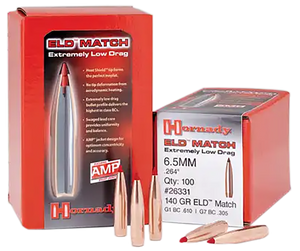
Hornady 30731 ELD Match Target 30 Cal .308 208 gr Extremely Low Drag-Match (ELD-M)
$53.06
$74.95
Hornady

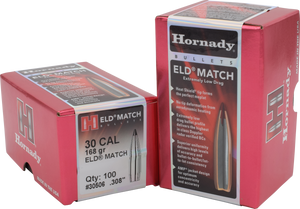
The Hornady ELD Match Target .308 225 gr bullet is a match-grade reloading component built for precision rifle shooters who demand extreme low drag and exceptional accuracy downrange. ELD Match bullets are engineered specifically for target and competition use, delivering the ballistic consistency needed for competitive shooting, long-range hunting, and precision rifle applications where every shot counts.
ELD Match bullets feature Hornady's proprietary Extremely Low Drag (ELD) design, which combines a secant ogive profile with a sleek boat-tail configuration. This aerodynamic shape minimizes drag across the velocity spectrum, resulting in flatter trajectories, less wind drift, and more predictable performance from 100 yards to extended range. The 225-grain weight in .308 caliber is a popular choice for heavier .308 loads, offering excellent sectional density for deep penetration and energy retention.
The bullet's construction uses a lead core with an InterLock ring that mechanically locks the core to the jacket, promoting consistent expansion and weight retention. The specially designed jacket provides reliable performance and the structural integrity needed for the high velocities and precision required in match-grade ammunition. The match-grade design ensures uniform concentricity and bullet-to-bullet consistency, which translates to tighter groups and more reliable ballistics when you're handloading for your precision rifle.
Whether you're loading for F-Class competition, long-range target work, or precision rifle matches, the ELD Match's low-drag profile and consistent construction help you get the most out of your .308 platform. Reloaders appreciate Hornady's reputation for quality components and the performance gains these bullets deliver in precision applications.
| Caliber | .308 / 7.62mm |
| Bullet Weight | 225 grains |
| Bullet Type | ELD Match (Extremely Low Drag) |
| Part Number | 30904 |
| Manufacturer | Hornady |
ELD Match is designed for target shooting and competition where maximum accuracy and ballistic consistency are the priority. ELD-X is built for hunting applications, with expansion characteristics optimized for game. Match bullets focus on uniformity and drag reduction; hunting bullets prioritize expansion and energy transfer.
ELD Match bullets are designed for use in any .308 Winchester rifle, including AR-10 platforms, bolt-action precision rifles, and semi-automatic .308 rifles. Consult your rifle's manual and reloading manuals to ensure proper seating depth and overall cartridge length for your specific firearm.
These are reloading components—bullets only. You'll need to pair them with appropriate brass cases, primers, and powder according to published Hornady reloading data for your specific loads.
Refer to Hornady reloading manuals and published load data for the 225-grain ELD Match bullet in .308 Winchester. Always start at the minimum load listed and work up carefully while monitoring for pressure signs. Never exceed maximum loads.
Hornady

Hornady

Hornady